
The Australian share market reached new record highs in February, with the S&P/ASX 200 Index gaining 3.7% to close at 9,198.6 points. The Australian dollar strengthened by 1.7%, now trading at 71.2 US cents. The Reserve Bank of Australia (RBA) responded to higher-than-expected inflation by increasing the target cash rate by 0.25% per annum, with the Cash Rate now at 3.85% per annum.
Global equity markets were mixed. The US S&P 500 decreased by 0.9%, the UK’s FTSE 100 advanced 6.9%, Japan’s Nikkei surged 10.4%, and Hong Kong’s Hang Seng declined by 2.8%.
Global financial markets experienced heightened volatility over the past month, driven largely by a sharp pullback in technology stocks, particularly within the Software‑as‑a‑Service (SaaS) sector. This volatility is expected to persist amid escalating geopolitical tensions following recent military action involving Iran.
Technology shares, and SaaS companies in particular, have recorded notable declines as investor sentiment shifts away from high‑valuation growth stocks. Markets are reassessing elevated valuation multiples, moderating growth expectations, and the disruptive influence of artificial intelligence on traditional subscription‑based software business models.
The chart below illustrates the relative share price declines of major SaaS stocks over the past year, highlighting the extent of the sector’s pullback.
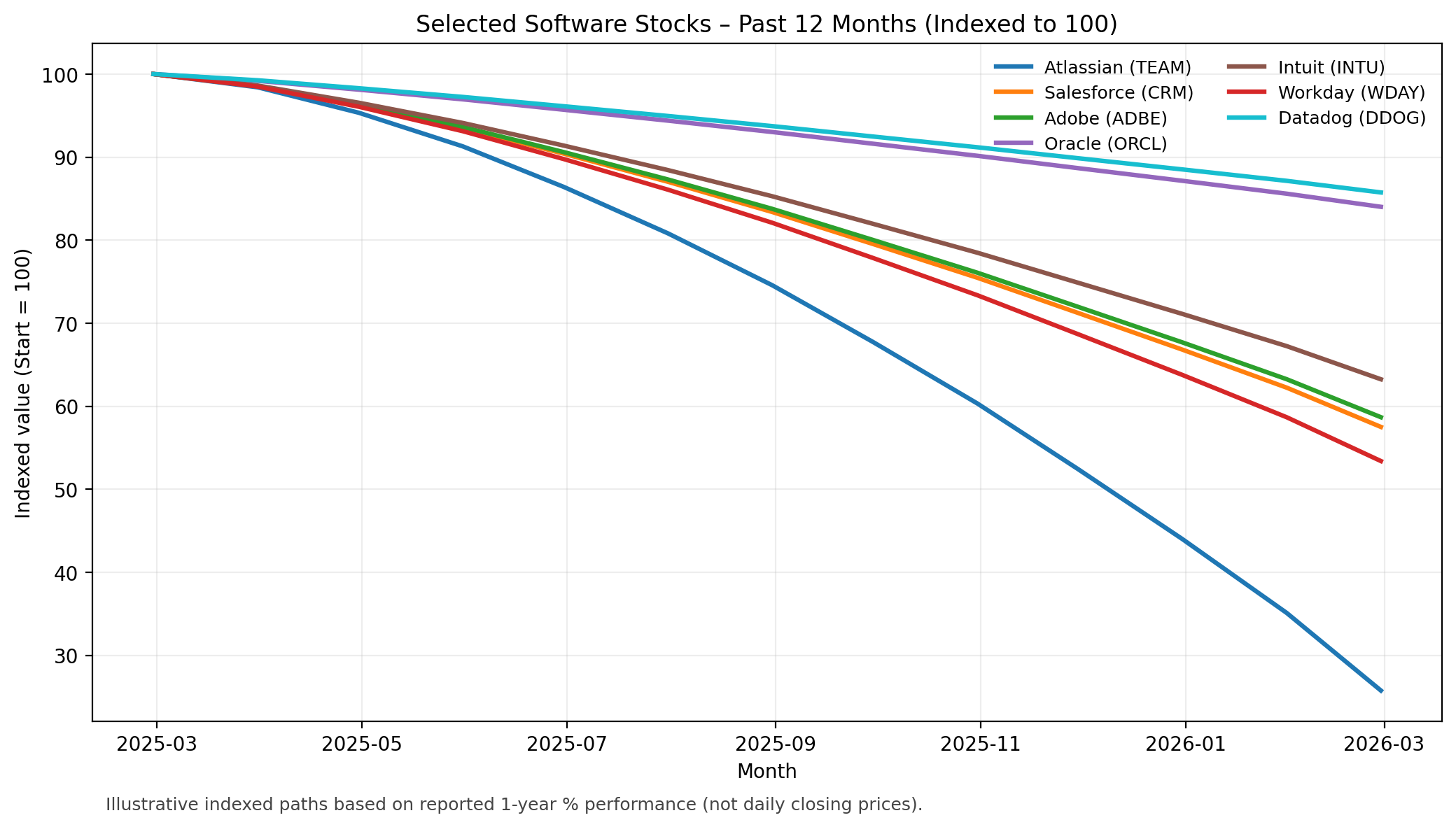
Source: Yahoo Finance
While many technology companies continue to deliver solid revenue and earnings outcomes, investor focus has increasingly turned toward profitability, pricing power, and the sustainability of long‑term growth rather than growth at any cost. As a result, technology stocks have become more sensitive to negative news flow and earnings guidance, leading to short‑term weakness despite otherwise stable underlying fundamentals.
Markets are also expected to respond cautiously to escalating military strikes involving Iran over the weekend, heightening concerns about broader regional instability in the Middle East. Investor attention is likely to centre on energy supply risks, particularly the potential disruption of oil shipments through the Strait of Hormuz, a critical global transit route for crude oil.
While geopolitical headlines can be unsettling, it is important to distinguish between short‑term market reactions and long‑term investment fundamentals. Historically, such events have tended to create temporary volatility, with markets adjusting as uncertainty diminishes.
For diversified investors, periods like these underscore the importance of maintaining a well‑structured portfolio across asset classes. Attempting to time markets in response to news events can increase risk and lead to unintended outcomes.
In our view, a disciplined investment approach aligned with long‑term objectives and cash‑flow needs remains the most effective way to navigate uncertain market environments.
We continue to monitor global developments closely. If you have any questions about how recent market events may affect your investments, or would like to review your strategy, please contact us.
This article contains general information only and does not constitute financial advice. We strongly recommend consulting your financial adviser to determine whether this information is appropriate for your personal circumstances, financial situation, and investment objectives