
August 2026 Market Wrap
Inflation has once again become the dominant theme for investors, consumers and policymakers as attention turns to the Reserve Bank of Australia's September meeting. While the Reserve Bank left the cash rate unchanged at 4.35% p.a. during its August meeting, recent inflation data has increased speculation that further rate increases may be required in coming months.
Australian share markets delivered a modest gain during August, with the S&P/ASX 200 Index rising 1.1% over the month to close at 9,076 points.
International markets were generally stronger, with the US S&P 500 gaining 2.6% and Japan's Nikkei Index rising 3.0%. The Australian dollar also strengthened, appreciating by 2.0% against the US dollar to finish the month at approximately 71.7 US cents. Hong Kong's Hang Seng Index declined 1.2%, while the UK's FTSE 100 was broadly unchanged.
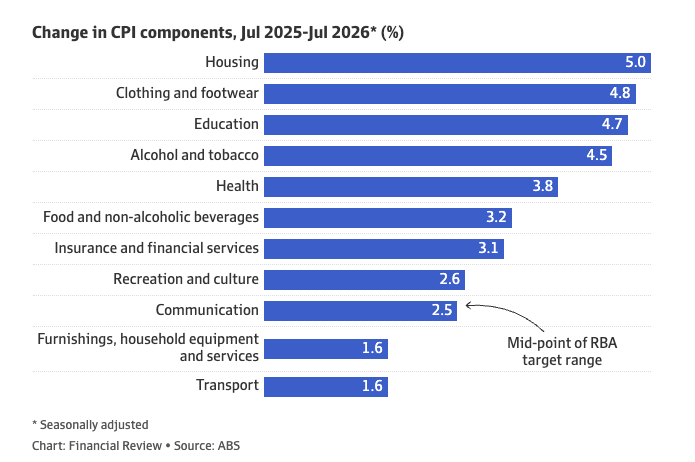
Recent inflation data has reinforced concerns that price pressures remain more persistent than anticipated. While headline inflation has moderated from the highs experienced in recent years, underlying inflation remains elevated and, importantly, broad-based across the economy. The chart below highlights annual price increases across key components of the Consumer Price Index.
Source: ABS / Financial Review
The significance of this data is not simply the level of inflation but its breadth. Housing costs rose 5.0% over the past year, education increased 4.7%, alcohol and tobacco 4.5%, and health costs 3.8%. Seven of the eleven major categories monitored by the Australian Bureau of Statistics are currently recording inflation above the midpoint of the RBA's target range. This suggests inflation pressures are no longer confined to a handful of sectors but are becoming more deeply embedded throughout the economy.
Adding to the inflation challenge is the continued resilience of household spending. Despite higher borrowing costs and ongoing cost-of-living pressures, consumer spending has remained stronger than many economists expected. As a result, a growing number of economists and major banks are now forecasting the possibility of further rate increases should inflation fail to moderate over coming months.
For investors, the prospect of interest rates remaining higher for longer creates both challenges and opportunities. Higher interest rates typically place pressure on borrowers and can weigh on property prices and economic growth. However, they also support improved returns from cash investments, term deposits and many fixed interest securities. The current environment highlights the importance of maintaining a diversified portfolio capable of performing across a range of economic outcomes.
While higher inflation and the potential for additional rate increases may create periods of short-term market volatility, it is important to remember that markets have successfully navigated numerous inflation cycles and interest rate environments throughout history. Attempting to predict short-term market movements based on individual economic releases can often prove counterproductive, particularly when investor sentiment shifts rapidly in response to changing expectations.
Looking ahead, investors will be closely watching the RBA's September meeting, along with forthcoming inflation and employment data, for further clues on the future direction of interest rates. While economic conditions remain uncertain, our view remains that a disciplined investment approach aligned with long-term objectives and cash flow requirements is the most effective way to navigate changing market environments.
If you have any questions regarding recent market developments, please contact our office.
This article is general information only and is not intended to be a recommendation. We strongly recommend you seek advice from your financial adviser as to whether this information is appropriate to your needs, financial situation, and investment objectives.