
Global investment markets delivered mixed results over the month of July, while Australian shares continued their positive momentum. The S&P/ASX 200 Index rose 2.3% to close at 8,976.8 points. The Australian dollar also strengthened during the month, rising 1.6% against the US dollar to approximately USD 0.70.
Overseas markets delivered mixed results. The US S&P 500 was broadly unchanged, falling 0.1%, while the UK FTSE 100 rose 3.5%. Japan's Nikkei Index declined 8.1%, while Hong Kong's Hang Seng Index recorded a strong gain of 13.1%.
One of the more significant developments this year has been the emerging softness in Australian residential property markets. After several years of strong gains, housing conditions are showing signs of moderation as higher interest rates continue to impact borrowing capacity and household budgets.
Source: Cotality
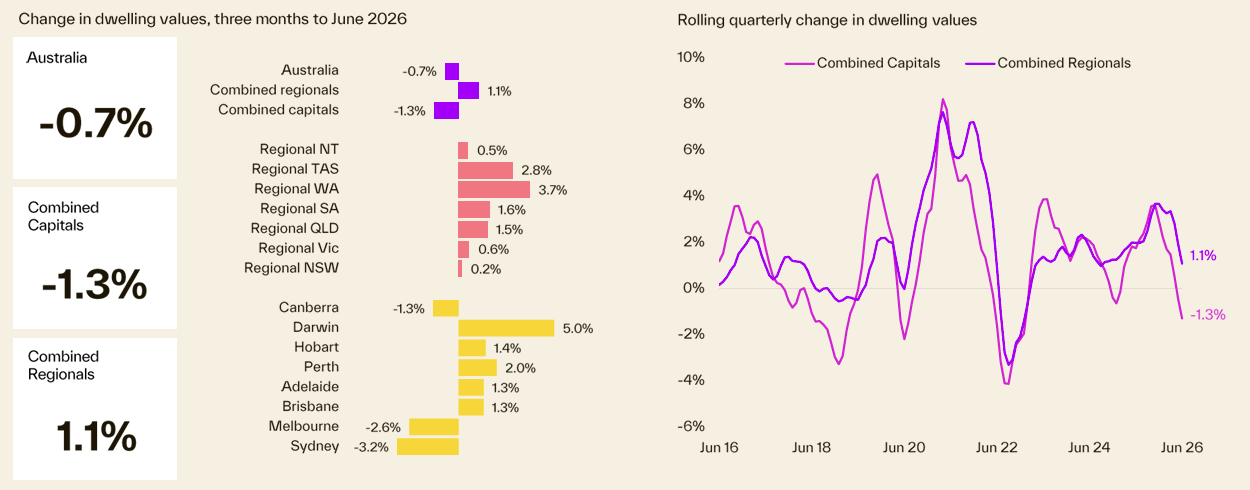
As shown above, housing data highlights this trend. Australian dwelling values fell 0.7% over the three months to June, representing the largest quarterly decline in national home values since early 2023. Capital city markets were particularly weak, with values falling 1.3% over the quarter, while regional markets continued to demonstrate greater resilience, rising 1.1%.
Sydney and Melbourne have led the downturn. Sydney dwelling values have fallen 3.2% over the quarter and now sit below their January 2026 peak, while Melbourne values declined 2.6% over the same period.
The data suggests the slowdown extends beyond residential property prices alone. Auction clearance rates have fallen steadily throughout 2026, properties are taking longer to sell, and housing supply is increasing as more listings come to market.
At the same time, buyer demand has weakened as higher mortgage rates reduce affordability and borrowing power. In addition, recent Federal Budget changes are reducing investor demand, as investors reassess the attractiveness of residential property following the proposed reforms.
Commonwealth Bank recently downgraded its housing market outlook, noting that the Budget reforms may reduce demand for established investment properties and place some downward pressure on future property price growth.
This does not necessarily mean investors should be concerned. Residential property remains an important long-term asset class and cyclical periods of weaker growth are a normal part of the investment landscape. However, it does highlight the importance of maintaining appropriate debt levels, strong cash flow and a diversified investment strategy rather than relying solely on ongoing property prices..
As always, successful investing requires a long-term focus. Remaining disciplined and diversified remains the most effective approach during periods of uncertainty.
Disclaimer:
This article is general information only and is not intended to be a recommendation. We strongly recommend you seek advice from your financial adviser as to whether this information is appropriate to your needs, financial situation, and investment objectives.