
October produced mixed results across global markets. The Australian share market was one of the stronger performers, with the S&P/ASX 200 rising 1.4% to finish the month at 8,908 points, while the UK FTSE 100 gained 1.2%. The US S&P 500 eased 0.9%, while Asian markets were weaker, with Japan's Nikkei falling 5.2% and Hong Kong's Hang Seng declining 5.4%.
The Australian dollar also strengthened during the month, rising 1.3% against the US dollar to around US70.4 cents. There was no Reserve Bank of Australia (RBA) Board meeting during October, with the cash rate remaining at 4.60%.
Despite no RBA board meeting, inflation was again the major economic story, with the latest reading coming in hotter than expected. This has changed expectations considerably and the market is now widely expecting the RBA to increase interest rates when the Board meets this week.
While movements in interest rates, inflation and share markets naturally attract plenty of attention, they are also a good reminder of just how difficult it is to predict what will happen next. Markets that perform strongly one year can disappoint the next, economic conditions change and investment leadership continually shifts.
The difficulty in predicting what comes next is precisely why diversification is so important.
It can be tempting to look at whichever investment market has performed particularly well in recent years and question why we should invest anywhere else. US shares are a good example. The S&P 500 has delivered very strong returns over recent years, which can create the impression that simply investing more heavily in the US share market is all that is required.
History tells us it is not quite that simple.
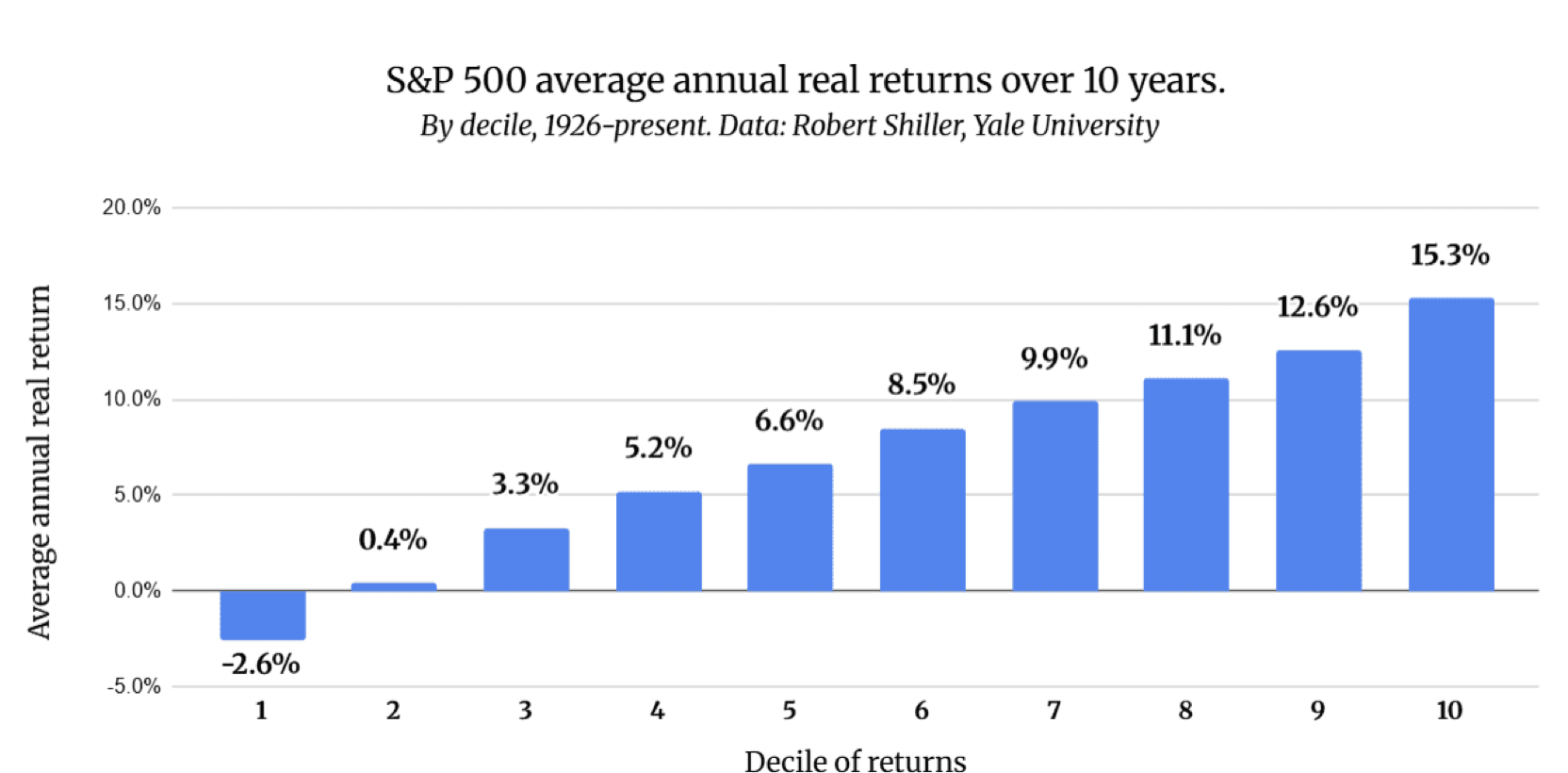
The chart below looks at the average annual real return (i.e. after inflation) from the S&P 500 over 10-year periods since 1926, dividing the results into ten groups from the worst outcomes through to the best.
Source: Marketwatch
The range of outcomes is quite remarkable. In the worst 10% of 10-year periods, the S&P 500 produced an average real return of negative 2.6% per annum. In the next 10%, the average real return was only 0.4% per annum. At the other end of the scale, the best 10% of periods produced an average real return of 15.3% per annum.
Importantly, every one of these represents a 10-year investment period.
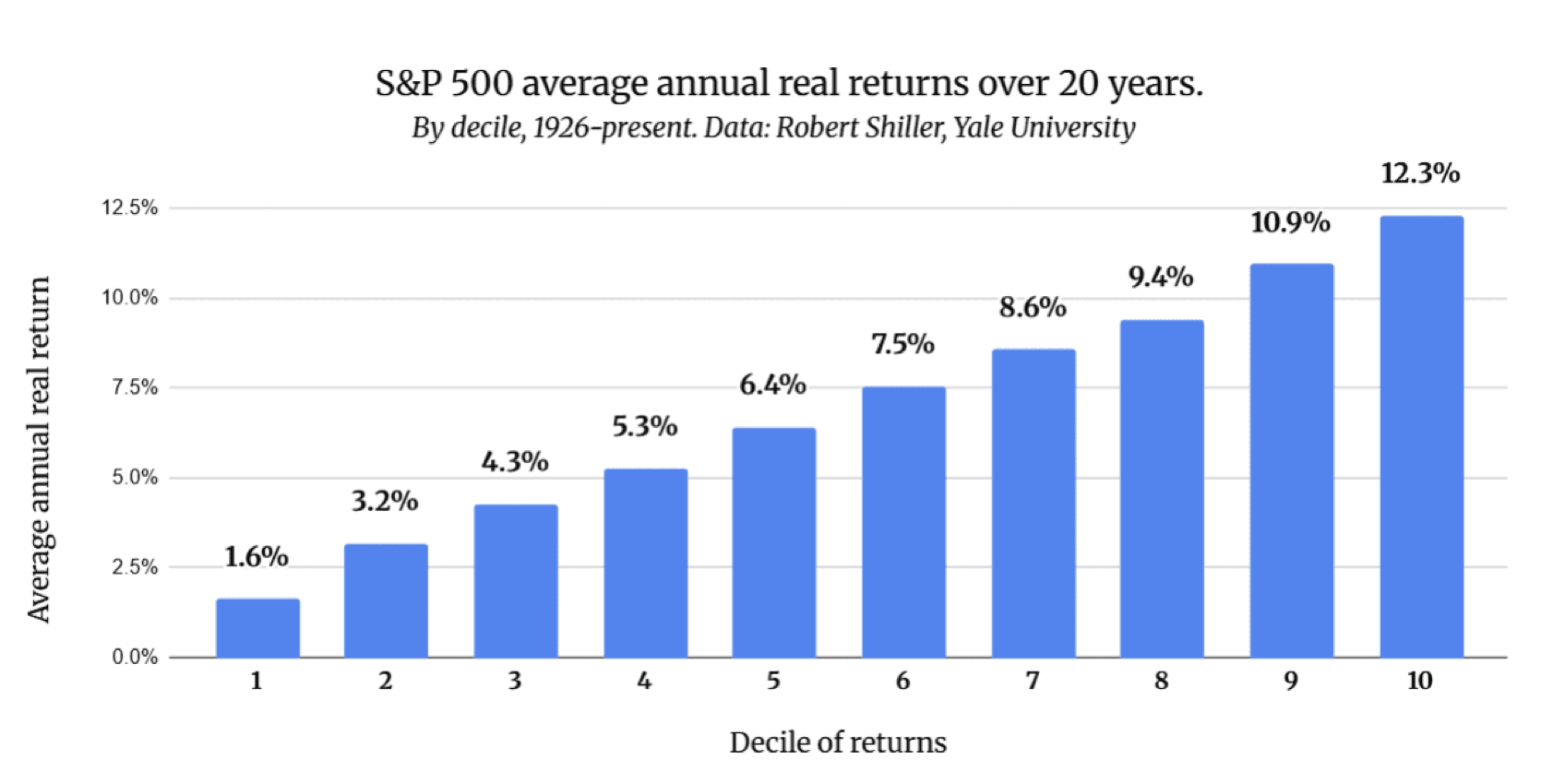
Extending the investment timeframe to 20 years certainly improves the picture, but there is still a significant difference between the best and worst outcomes.
Source: Marketwatch
Over these 20-year periods, the average annual real return ranged from only 1.6% per annum in the lowest 10% of outcomes to 12.3% per annum in the highest 10%. That is an extraordinary difference in outcome from investing in exactly the same share market, simply over different periods.
The point is not that investors should avoid shares. Quite the opposite. Shares remain an important part of building wealth over the long term. What the charts demonstrate is that time helps reduce investment risk, but it doesn't eliminate it.
Rather than relying on one share market, one country or one investment theme, we spread investments across different asset classes, geographic regions, industries and investment styles. The reason is relatively simple: we don't know in advance which investment will perform best next.
Importantly, some part of a properly diversified portfolio will almost always disappoint you. That isn't a flaw in diversification. It is actually evidence that the portfolio is doing what it is designed to do. If every investment in a portfolio is rising and falling together, there probably isn't much diversification in the first place.
The temptation is always to look at the investment that has recently performed poorly, sell it and put more money into whatever has recently performed best. Unfortunately, that can result in continually selling investments after a period of weakness and buying others after they have already performed strongly.
We don't believe successful long-term investing requires us to continually predict which country, company, asset class or investment theme will be the next winner. Our approach remains to build well-diversified portfolios, rebalance them when appropriate and allow different investments to play their role over time.
The objective isn't to own the best-performing investment every year. It is to build a portfolio capable of delivering attractive long-term returns without requiring us to correctly predict the future. That may not always be the most exciting investment strategy, but we believe it remains the most sensible one.
As always, if you have any questions regarding your investment portfolio or financial strategy, please contact us.
This article contains general information only and does not constitute financial advice. We strongly recommend consulting your financial adviser to determine whether this information is appropriate for your personal circumstances, financial situation and investment objectives.